Intro
You may also enjoy:
The Mohs Hardness Scale measures a mineral’s resistance to scratching. Developed in 1812 by Friedrich Mohs, this scale ranks minerals from 1 (softest) to 10 (hardest). It is one of the most important tools for identifying minerals.
• Ranks minerals by scratch resistance
• Uses a scale from 1 to 10
• Essential for mineral identification
What Does Hardness Mean?
Hardness refers to how easily a mineral can be scratched.
• A harder mineral scratches a softer one
• A softer mineral cannot scratch a harder one
• Hardness is not the same as strength or toughness
A mineral can be hard but still break easily.
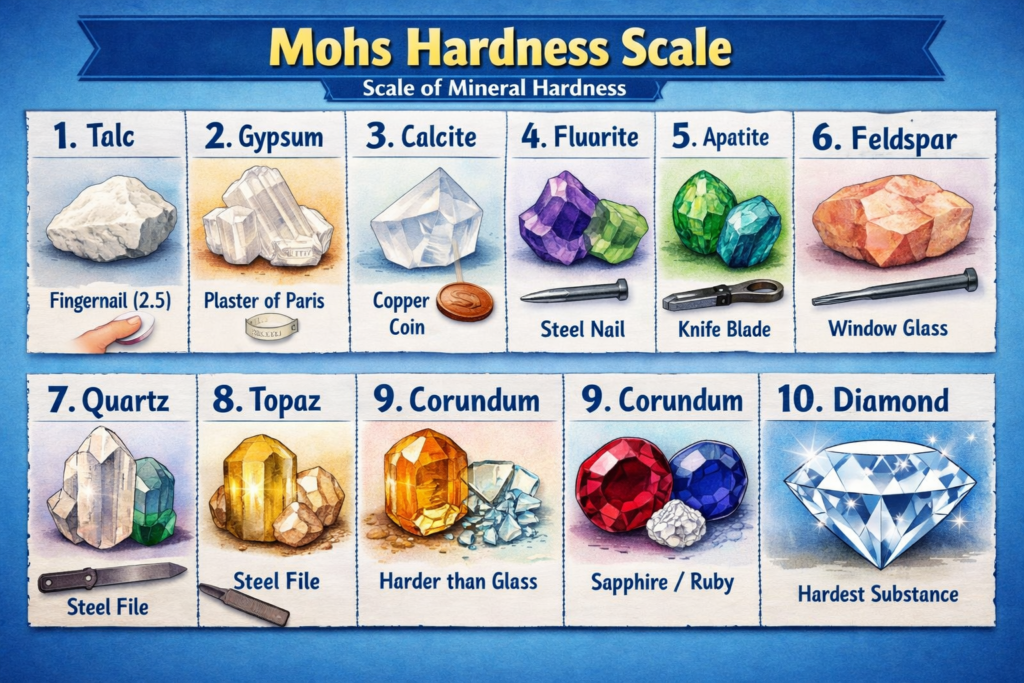
The Mohs Hardness Scale (1–10)
The standard reference minerals are:
1 — Talc
2 — Gypsum
3 — Calcite
4 — Fluorite
5 — Apatite
6 — Feldspar
7 — Quartz
8 — Topaz
9 — Corundum
10 — Diamond
Each number represents a mineral that can scratch the ones below it.
How to Perform a Hardness Test
Begin with simple scratch comparisons.
• Try scratching the specimen with a fingernail (about 2.5)
• Use a copper coin (about 3)
• Use a steel nail (about 5–6)
• Compare with quartz (7) if available
Always test carefully to avoid damaging good specimens.
Why Hardness Is Important
Hardness helps narrow identification quickly.
For example:
• If a mineral scratches glass (hardness ~5.5), it is likely harder than 6
• If it can be scratched by a fingernail, it is very soft
Hardness is one of the most reliable physical properties.
Common Beginner Mistakes
• Confusing hardness with density
• Applying too much force
• Damaging delicate crystals unnecessarily
Test on inconspicuous areas when possible.
Conclusion
The Mohs Hardness Scale is a simple but powerful tool for identifying minerals. By comparing scratch resistance, beginners can quickly narrow down possibilities and improve identification accuracy.
You might enjoy: